
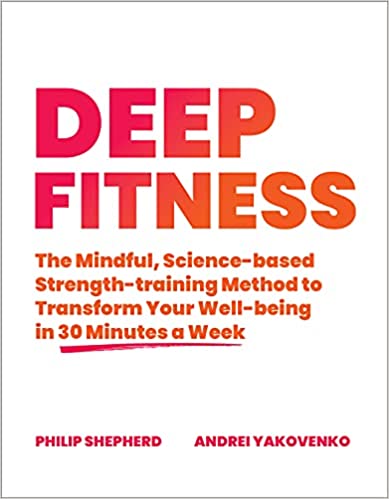
Deep Fitness by Philip Shepherd and Andrei Yakovenko takes an interesting approach to strength training. The book’s full subtitle—The Mindful, Science-Based Strength Training Method to Transform Your Well-Being in Just 30 Minutes a Week—immediately raises an intriguing question:
Can a small amount of highly focused exercise really produce meaningful improvements in fitness and health?
The authors believe it can.
Deep Fitness combines the principles of High Intensity Training (HIT) with the practice of mindfulness. The goal is not simply to exercise harder, but to become more aware of what you are experiencing while performing demanding exercise. As someone who has been involved in fitness education and High Intensity Training for decades, I found much of the book particularly interesting. The authors have done an impressive job of researching the scientific foundations of strength training and explaining why intense exercise can have such profound effects on health.
There are also some areas of the book that I disagree with, particularly the exercise selection and the lack of discussion about traditional free-weight training. Overall, however, Deep Fitness is a well-researched and thought-provoking book that is worth considering for anyone serious about strength training.
The Science Behind High Intensity Training
The first half of Deep Fitness is devoted primarily to explaining High Intensity Training and the science behind strength training. This was my favorite part of the book. The authors provide a substantial amount of scientific information about the benefits of strength training, particularly as they relate to maintaining health and physical function as we age. As an exercise science enthusiast, I appreciated the amount of research and documentation supporting their explanations.
One particularly important topic introduced early in the book is sarcopenia—the age-related loss of muscle mass and strength. The authors describe sarcopenia as a modern epidemic and provide an extensive list of health problems associated with declining muscular strength and mass. The list occupies roughly a page and a half of the book and makes an important point: Maintaining muscle and strength is about much more than looking fit. It is an important component of maintaining health and independence as we age. That is a message that deserves considerably more attention.
Beginning with Chapter Two, The Next Health Revolution, and continuing into Chapter Three, The Principles of Strength Training, the authors explore the science behind effective resistance training. They discuss the importance of muscular intensity, proper exercise technique, and recruiting the muscle fibers necessary to produce meaningful adaptations.
The book also gives appropriate attention to Arthur Jones, one of the most influential figures in the development of High Intensity Training. Jones challenged many conventional ideas about exercise and emphasized brief, intense, carefully performed workouts. The famous West Point Project Total Conditioning study is also discussed. The research examined different approaches to physical conditioning and provides an interesting historical perspective on strength and cardiovascular training. This somewhat forgottrn study was lead by Jones at the U.S. Army Academy in 1975.
The authors also examine the work of Kenneth Cooper, who popularized the term “aerobics” and strongly advocated steady-state endurance exercise. Deep Fitness makes a compelling argument that aerobic exercise alone is not enough. Cardiovascular fitness is certainly important, but it does not replace the need for strenuous muscular exercise.
Strength Training, Muscle Failure, and Myokines
One of the strongest sections of the book is its discussion of strength-training principles.
he authors emphasize performing exercises with slow, controlled movements and strict technique, eventually taking the muscles to momentary failure. They also discuss super-slow training, in which each repetition is performed extremely slowly.
At one point, they describe an even more extreme variation that could almost be called “Super Duper Slow.” The technique involves approximately 30 seconds to lower the resistance, 30 seconds to raise it, and another 30 seconds to lower it again.
That means approximately 90 seconds for just 1½ repetitions. Whether someone needs to train quite that slowly is certainly debatable, but there is no question that such a technique demands tremendous concentration and muscular effort. Im my opinion this very difficult, effective and safe method does not need to be considered as a way to train by the vast majority of people. It seems too boring, mundane and counter intuitive to use as a regular training protocol.
Why Myokines Matter
Another fascinating scientific topic discussed in Deep Fitness is the role of myokines. Myokines are signaling molecules produced and released by skeletal muscle in response to muscular contractions. Their effects extend far beyond the muscles themselves.
Research has shown that myokines are involved in communication between skeletal muscle and other tissues throughout the body, including fat, bone, liver, pancreas, cardiovascular tissue, the immune system, and the brain. This helps explain why exercise can have such wide-ranging effects on the body.
The authors discuss potential benefits associated with exercise-induced myokine activity, including:
- Reducing dangerous visceral fat
- Supporting bone health
- Improving blood vessel function
- Supporting learning and memory
- Reducing the risk of metabolic disease
- Helping regulate inflammation
- Supporting healthy tissue function
This is one of the areas where Deep Fitness does an excellent job of connecting exercise physiology with overall health.Exercise isn’t simply about building bigger muscles or burning calories. Contracting your muscles can trigger biological processes that affect your entire body.
Mindfulness and Mindful Strength Training to Failure
The second major concept introduced by the authors is MSTF—Mindful Strength Training to Failure. The basic idea is simple: Instead of mentally checking out while exercising, pay close attention to the experience.
Mindfulness generally involves being fully present in the moment and observing what is happening without immediately judging the experience. Although mindfulness is often associated with meditation, meditation is only one way to practice mindfulness. Exercise can be another.
When performing a demanding set of resistance exercise, there is an enormous amount happening. You can feel the muscles contracting, fatigue developing, breathing changing, and the resistance becoming progressively more difficult to move. MSTF encourages you to pay attention to all of it.
Learning to Appreciate Exercise Intensity
Arthur Jones famously said:
“If you enjoy exercise chances are you are doing it wrong.”
The statement was intended to emphasize just how demanding productive High Intensity Training can be. Training a muscle to momentary failure is both physically and mentally
difficult. It can produce significant discomfort, and most people would probably not describe the final repetitions of a hard set as “fun.”
But there is an interesting psychological problem here. If someone views exercise entirely as something unpleasant, how likely are they to continue doing it for years?
This is where the mindfulness component of Deep Fitness becomes particularly interesting. Rather than automatically labeling the sensations associated with intense exercise as “pain,” a person can learn to observe those sensations without immediately judging them as negative.
Personally, I think the terminology matters. Instead of thinking, “This hurts,” someone might think, “I’m experiencing intense muscle fatigue.” The term for the exercise pain might best be changd to muscle fatigue sensation.
That doesn’t make the exercise easier. But it may change the person’s psychological relationship with the experience. Over time, that change in perspective could make it easier to consistently perform challenging workouts.
The Exercise Section: Where I Have Some Reservations
Unfortunately, I found one significant weakness in Deep Fitness: the exercise section. The book includes detailed descriptions and illustrations of numerous exercises. There is a section devoted to machine exercises and another covering body-weight and resistance-band exercises.
The machine exercises are generally well presented, and the photographs appear to have been taken at the authors’ fitness facilities, New Element Training. The body-weight exercises are also useful. My biggest concern is the emphasis on resistance bands.
Resistance bands certainly have their place. They are inexpensive, portable, and better than having no resistance-training equipment at all. However, they have significant limitations when compared with properly designed resistance-training machines or free weights. One important issue is the strength curve of an exercise. Arthur Jones, for example, designed variable-resistance cams for Nautilus machines to better match the changing strength capability of a muscle throughout a range of motion.

A resistance band produces a very different and inferior resistance curve. That doesn’t make bands useless. But it does make them a limited substitute for other forms of resistance training.
The Missing Piece: Barbells and Dumbbells
More surprising to me is the complete lack of discussion of barbells and dumbbells. This is a significant omission. Barbells and dumbbells remain among the most common forms
of strength-training equipment in the world. They are found in virtually every commercial gym and are widely available for home training. In the overall history of exercise they are considered perhaps the most significant invention ever.
Someone reading Deep Fitness is likely to want to apply the principles discussed in the book to the equipment they already have. For that reason, I believe the authors should have included an entire section explaining how their High Intensity Training principles could be applied to free-weight exercises.
The book’s philosophy is valuable. But readers also need practical guidance on how to implement that philosophy with the equipment available to them.
The Personal Stories Behind Deep Fitness
One of the most enjoyable sections of the book is the collection of personal fitness stories near the end.
Four individuals describe their experiences with Mindful Strength Training to Failure, including the two authors themselves. They explain their individual fitness journeys and describe how High Intensity Training became an important part of their lives.
I found these stories particularly interesting because I have spent many years both teaching and participating in High Intensity Training. I’m always interested in hearing how other serious trainees approach exercise. One important point comes through clearly in these stories:
High Intensity Training isn’t a single exercise program.
Instead, it is a collection of principles that can be applied to an individual’s own training program. Different people can use the same fundamental principles while performing different exercises, using different equipment, and following different routines. That flexibility is one of the strengths of the HIT approach.
My Overall Deep Fitness Review
Despite the shortcomings I’ve mentioned, I consider Deep Fitness an excellent resource.
The scientific information is one of the book’s greatest strengths. The authors do an excellent job explaining why physical activity—particularly challenging resistance exercise—can have such profound effects on our health. Their discussion of High Intensity Training principles is also impressive.
Most recreational exercisers don’t necessarily understand how intensity, muscular fatigue, exercise technique, recovery, and progressive overload work together to produce results. Deep Fitness provides a detailed explanation of these concepts while also introducing an interesting psychological component through mindfulness.
I particularly enjoyed the attempt to connect the physical experience of intense exercise with the mental experience of being fully present during that exercise.
I don’t agree with everything in the book. The lack of discussion about barbells and dumbbells is a significant weakness, and I believe the resistance-band section could have been handled differently. But those criticisms don’t diminish the book’s overall value.
Is Deep Fitness Worth Reading?
Yes.
If you are interested in strength training, High Intensity Training, exercise science, aging, or the psychological side of exercise, Deep Fitness is worth reading. The book asks us to look at exercise differently. Instead of simply trying to “get through” a workout, perhaps we should pay attention to what is actually happening during those difficult moments.
The muscle fatigue.
The effort.
The changing sensations.
The mental challenge.
And the knowledge that those difficult muscular contractions may be producing benefits throughout the body. That combination of science, High Intensity Training, and mindfulness is what makes Deep Fitness different from the typical fitness book—and ultimately makes it worth a look.
About the Author
David Waters is a fitness professional with more than 40 years of experience in the fitness field. He holds a Bachelor of Science degree in Physical Education from the University of Massachusetts Amherst and has worked as a personal trainer, fitness director, fitness facility manager, competitive athlete, author, and fitness educator.
He is the author of The Science and Practice of High Intensity Training, available from SuperFitnessForever.com.
Fitness Information Disclaimer
The information provided on SuperFitnessForever.com is intended for general educational and informational purposes only. It is not intended to diagnose, treat, or prevent any medical condition, nor does it constitute medical or professional advice.
The information on this website does not prescribe an exercise program for any individual. Exercise involves inherent risks, and results can vary from person to person. SuperFitnessForever.com and David Waters are not responsible for any injury, loss, or damage that may result from the use of information provided on this website or participation in any exercise program.
Consult your physician or other qualified healthcare professional before beginning a new exercise program, particularly if you have a medical condition, injury, or concerns about your ability to exercise safely.
Affiliate Disclosure Some links on this website are affiliate links. This means I may earn a small commission if you purchase a product through one of these links, at no additional cost to you. I only recommend products, books, and services that I believe may be useful to my readers. Thank you for supporting my website.