
Proper Exercise Form
What is Proper Exercise Form and why does it matter?
It is often stated that a person should do their weight training exercise in “good form”. That is certainly true if you are looking for an effective and safe workout. But what exactly does this “good form” really mean? Unfortunately many people do not understand the form or technique you should use when properly performing strength training exercises. This is easily seen at most gyms where people are weight training, as so many folks fail to focus on proper technique at all. The reason you want to use proper exercise form is simple. It makes the exercise more effective and safer.
When you conduct a strength training exercise using barbells, dumbbells, weight training machines or a body weight exercise the speed of movement is perhaps the most import technique factor. As a rule you should move in a slow and controlled movement with no use of momentum to lift the resistance and no dropping of the weight. Faster movement decreases the tension on the working muscles thru most of the range of motion. This is a physical fact dictated by the Laws of Physics.
Speed of Motion
So if going slowly is important than how slow should you move? Well, once upon a time it was generally suggested to use 2 seconds to lift and 4 seconds to lower. This obviously leads to 6 seconds for one repletion to be completed. As a general rule this is fine and will work well. It is slower and more difficult than what many people do when training. A visit to your local gym will probably show you that most people go relatively fast. It is not uncommon to see a person complete a set of ten reps in about 10 to 15 seconds. This is far too fast for effective training. It does not work the various types of muscle fibers and it can potentially be dangerous, leading to joint or muscle injuries.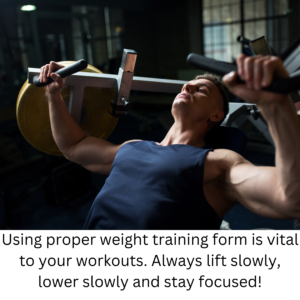
Why does this occur? Probably in is a combination of two factors. One is that most people are ignorant of the fact that moving faster is less effective. Another factor is that the human body usually attempts to make a physical task easier to perform. In the case of weight training this can be accomplished by accelerating the speed of movement. This will happen unless a person knows that they need to disciple themselves to move slower and work your muscles harder. That is actually one of the main points of High Intensity Training, to make your muscle work harder that they are used to.
So is this 2 second lift and a 4 second lowering the best way to proceed? Well actually no, it is probably not. While it is fine and will improve most people’s workouts, going even slower will have more benefit. Fore example taking a full 4 seconds to lift with 4 seconds to lower will increase the time under tension for each rep go from 6 seconds to 8 seconds. It will also decrease the momentum used on the concentric (lifting) phase of the movement. Decreasing the speed even further will continue to increase the difficulty of the exercise. My personal recommendation is to use 5 seconds on the lifting with 5 seconds to lower back down.
Super Slow Training
In the early 1980s Ken Hutchins developed the Super Slow training method. This was originally used to assist senior citizens and people with osteoporosis because of the safety factor of decreasing force on bone and tissue. While decreasing the unwanted forces you are also increasing the tension on the muscles. The protocol used is usually to take 10 seconds to lift and 10 seconds to lower. Training is this manner requires a lot of disciple to maintain the proper slow speed. It is just play very hard to train using Super Slow Training. In addition the weight used will be usually significantly lower that a person may have used when performing faster reps. This is a sign that you are making the exercise harder, which is good. Many people are too concerned with “ego training” and demonstrating their strength rather than performing an exercise in the most effective manner. The basic point of this discussion about speed of motion is simply to stress the importance of eliminating momentum. To train in the most effective, efficient and safest manner you want to move in a slow and controlled manner.
Problems with Some Training Methods
One of the problems in fitness is that various aspects of exercise do not apply this principle for various reasons. Activities such as powerlifting, competitive weight lifting and CrossFit training use faster movements to achieve specific goals. This is fine for training for these types of sports and activities. But it should be understood that training for these types of sports, or any sport, is something different than exercising for general physical fitness and health benefits. You should understand this if you decide to exercise using CrossFit or Powerlifting methods that these methods do increase the risk of injury.
Most Power Lifters and Cross Fitters are not training for physical fitness in the safest and most effective manner, they are actually training for athletic performance improvement in their chosen activity. In general it is recommended that a serious athlete follow a High Intensity Training program along with their sport’s skill specific training to enhance their athletic capabilities. Many athletes make the mistake of performing exercises they believe are good strength exercises combined with skill movements. This is a mistake because the body’s neurological activity used in a given motor skill is specific to that specific given task.
Stronger muscles will allow for better performance of a specific skill. That muscle strengthening should be accomplished by using a proper training program. Trying to perform a sport movement with added resistance will not improve one’s ability to perform the actual sport skill. Simply put you do not want to try to imitate an athletic movement with weights and think it is a sensible exercise. Imagine if a golfer regularly trained with clubs that weighed twice as much as regulation golf clubs. Or perhaps a baseball pitcher practicing with a baseball that weighs far more that an actual baseball. Do you thing either of these approaches would work as good sports training?
Proper Exercise Form and Range of Motion
Another import aspect to performing a strength training exercise in good form is to work the target muscles thru a full range of motion. Whether the exercise is a compound (multiple joint) movement or a single joint motion (such as a barbell curl) the exercise should generally be a full range movement. The exercise will be a movement from an extended or stretched position and then you move from there to a fully contracted position.
For a simple example lets look at a chin-up or pull-up exercise. You can start from a full hanging position, begin by slowly pulling up until your pulling muscles are fully contracted. This position will be where you chin is slightly above the chin-up bar. Now since the pulling muscles, in this case it is primarily the latissimus and bicep muscles, you will want to hold that position. Do not just start back down. Hold for a full second or two with your chin above the bar. Holding for even longer will be even harder! Now after holding in this contracted position slowing lower yourself back down. When you get to the bottom position do not go back into a full hang. A full hang would result in a brief rest. You want to slowly start pulling back up when you are almost in the full hanging position.
Remember this is just one example of exercising the muscles thru a full range of motion. As pointed out you want to avoid a full hang position on this type of exercise. Similar to this you also want to avoid a “lock out” position on certain exercises. Moving into the locked out position will allow the bone structure to support the weight which will result in a brief muscle rest. It also puts stress on the joint which increases the potential for a hyperextension injury.
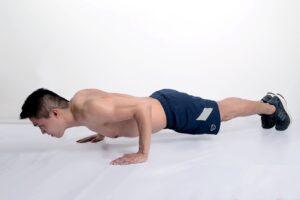 Here is an example of an exercise in which you want to avoid locking out. Assume you are doing a push up. Start in the top push-up position and slowing lower your body all the way down but do not rest your torso on the floor. When you reach the bottom do not rest on the floor but begin to slowly push back up to the top. Stop just short of locking out your arms at the top. This keeps tension on the working muscles. You want to avoid locking out when performing pushing type exercises such as any chest press, shoulder press, squat or leg press.
Proper Exercise Form and Body Stability
Along with using a slow and controlled speed of motion and working the target muscle thru their full range of motion there are a few other factors that should be considered. When strength training you want to put full mental focus on the movement being done by the working muscles. If you watch people weight training you will commonly see them tensing their face muscles, holding their breath and move non-involved body parts. Perhaps this happens because when the body is attempting to complete a difficult task it will try to incorporate addition muscles to assist.
However to properly work the targeted muscles you want to have the targeted muscles working with full intensity and you do not want to involve other extraneous muscles. If you begin to tense your face and neck muscles, which may happen as you approach momentary muscles failure, it will actually take away from the body’s ability to use the correct muscles. It can also lead to holding your breath. Obviously holding your breath is to be avoided.
Traditionally it has been recommended to exhale as you lift the resistance and to exhale as you lower back down. This is a fine approach to breathing. The important thing to do is to keep your breathing relaxed and as deep as your body requires so you do not hold your breath. The exact in and out, up and down timing may not be as important as remembering to breath fully as you go. Your body requires this influx of oxygen while exercising.
Other examples of using extra muscles that should not be involved would be arching your back as you do a barbell curl or bending your legs while doing an overhead dumbbell press. You obviously do not want your legs trying to assist you while performing an upper body exercise.
Some people mistakenly think that working on “stability and balance” should be part of proper exercise form while weight training. It is not uncommon that a person will be by sitting of a large rubber exercise stability ball while trying to lift dumbbells or train with weights while balancing on one leg. They mistakenly think that this balance factor helps to improve the exercise. In actuality it detracts from it somewhat. You need to activate addition muscles and nerves to maintain that balance instead of putting full focus on contracting the targeted muscles you want work to the point of muscle failure.
Proper exercise form means to keep your body in stable position thru out the exercise. On an upper body exercise machine that generally means to keep your feet flat you the floor and your back straight. Do not do any twisting or turning. In general dumbbell exercises should be done sitting down if it is possible for that particular exercise. In addition bilateral exercises (two sides at once) are preferred over unilateral exercises (one side at a time). An example here would be triceps pushdowns, usually done on a cable machine. Doing one are at a time may results in twisting the torso during the movement. Using both arms at once will help to keep you in a straight and stable, non-twisting position. It also takes half the time obviously.
Proper Exercise Form and Eccentric focus
Many exercise research studies have indicted the importance of the eccentric or the lowering phase of a strength training exercise. This is also referred to as the negative portion of the movement. This lowering of the weight phase is sometimes completely neglected by people as they weight train.
To get maximum benefit from your training you want to be sure you are incorporating eccentric muscle contraction into each exercise. As far back as the early 1970s Arthur Jones at the Nautilus Sports Medical Industries in DeLand Florida conducted a “negative only” training program to research this highly effective method of training. Is that particular study the subjects were mostly professional athletes and body builders. These individuals who were already above average in muscle strength, achieved dramatic strength increases in just a few weeks. Since then many other research studies have shown how important the eccentric portion of an exercise can be.
So how does the average person benefit from this knowledge? Simple, just lower the weight slowly after the lifting phase. As mentioned above strength training movements are very effective and safe when excess speed and momentum are eliminated. For example you can take 5 seconds to lift the weight up and then take a full 10 seconds to lower it back down. This will provide extended tension on the working muscles. Do not drop the weight back down! That is a common mistake. After you reach concentric (positive) muscle failure, the point at which you can’t continue to lift upward, then lower the weight back down very slowly. At this point your set will be competed and you muscles will be fully fatigued. Now you will be ready for full recovery from your high intensity effort.
It is easier said than done but by concentrating on the following points you will find yourself using good form and getting better (and safe) workouts.
-
- Perform a slow and controlled lifting motion
- Move thru the full range of motion
- Keep your muscles tensed as you lower the resistance down slowly
- Keep your breathing relaxed and only tense the working muscles as you work to momentary muscle failure
Below is fitness expert Molly Galbraith demonstrating a negative only chin-up.
_________________________________________________________________________________
David is the author of The Fitness Center Handbook which was originally written and published in 1988 and has been completely edited and updated for this current publication. Copyright registered with the US Library of Congress, 1988.
The information contained on this website is for educational purposes only. No attempt at prescribing an exercise
program has been made. The author shall not be held liable or responsible for any injury or damage resulting
from any individual’s participation in any exercise program. Individuals should consult with their physician prior to
undertaking an exercise program.
Proper Exercise Form Read More »